


Best BCAA Supplement & Powder in the UAE: Do You Need One, and Which to Buy
Jun 24, 2026
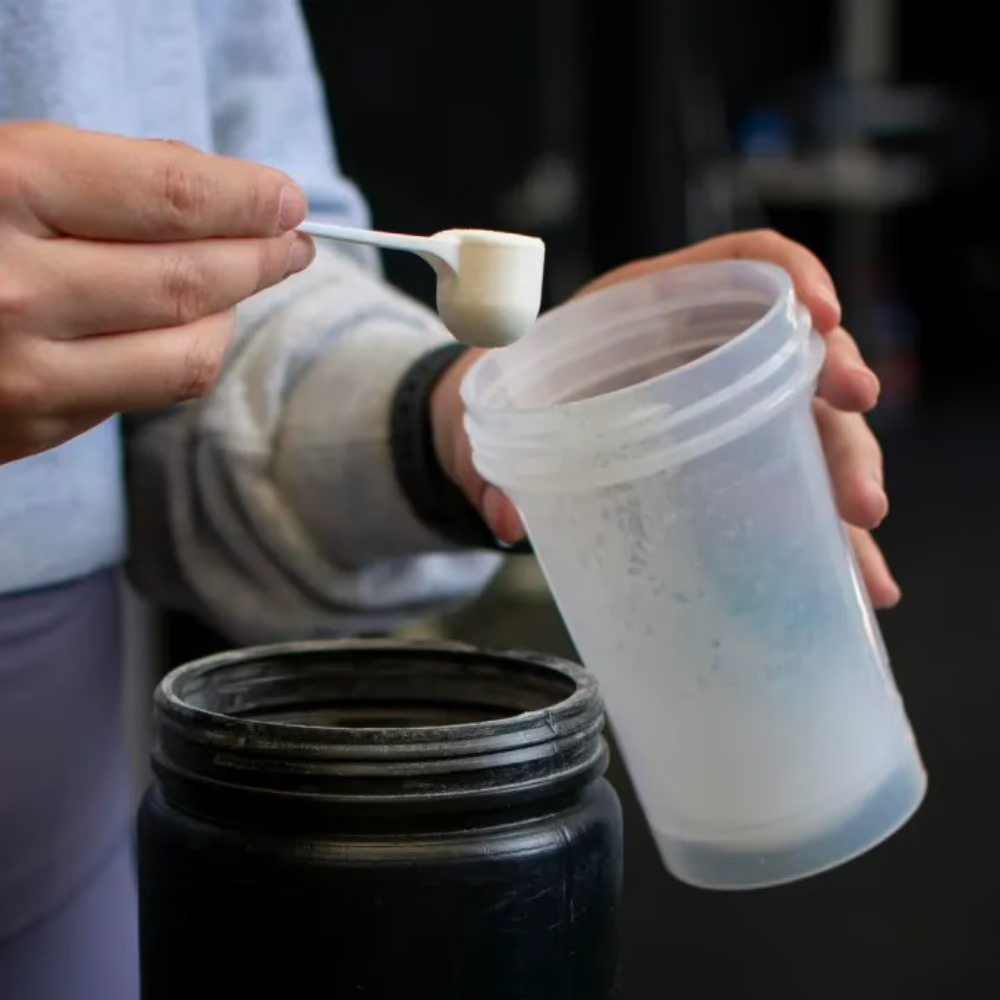
A BCAA supplement gives you three amino acids, leucine, isoleucine and valine, in a single scoop. Here is the honest version most shops skip. If you already hit your daily protein target, a separate BCAA adds little to your muscle growth. It has one genuine use backed by solid evidence, and if that use describes you, this guide shows exactly which one to buy in the UAE.
Most pages that rank for “best BCAA” start selling before they answer the question you are really asking, which is whether you need one at all. We will settle that first, then get to the buying part, because the right answer for you might save you a tub of money.
What is a BCAA supplement?
A BCAA supplement delivers three essential amino acids, leucine, isoleucine and valine, usually in a 2:1:1 ratio. Your body cannot make them on its own, so they have to come from food or a supplement. Leucine is the one that flips the switch on muscle protein synthesis, which is why these powders get sold to anyone who trains.
The “branched-chain” part simply describes their molecular shape. What matters to you is that they are three of the nine essential amino acids your muscles use to repair after a session. You will find them as flavoured powders, capsules, tablets and ready-to-drink bottles across MedX’s BCAA range in the UAE, so once you know whether you need one, the form is the only real decision left.
Do BCAAs actually work, and are they worth it?
BCAAs do one thing reliably and several things the marketing oversells. The honest verdict is that they reduce muscle soreness after hard training, and that is the benefit worth paying for. A review of 18 trials found delayed-onset soreness dropping by somewhere between roughly a quarter and two-thirds, depending on the dose and how trained the person was.
What they do not do is build more muscle than eating enough protein already does. When researchers pooled 22 controlled trials covering more than 500 people, BCAAs added nothing measurable to muscle growth once total protein intake was adequate. They are a tool with one sharp edge, not a magic powder. Keep that straight and you will spend your money well.
What BCAAs do | What BCAAs don’t do |
Reduce muscle soreness after hard training | Out-build a complete protein like whey |
Supply leucine, which signals muscle repair | Replace a full set of nine essential amino acids |
Give a low-calorie flavoured drink to sip mid-session | Burn fat or build muscle on their own |
Do you need a BCAA if you already take whey?
For most people the answer is no. Whey protein already contains a large dose of BCAAs, including more leucine per scoop than many standalone BCAA servings. Drink a whey shake and you have taken your BCAAs. The same goes for chicken, eggs, fish, dairy and other complete protein sources you already eat.
There is a deeper reason whole protein wins. BCAAs give you three of the nine essential amino acids, but muscle protein synthesis needs all nine present to actually build tissue. Three on their own raise the signal then run out of materials. In head-to-head trials, whey beats an equal dose of BCAAs for muscle building because whey brings the full set. If you take whey, a good whey protein already covers your BCAAs, and a separate tub is mostly insurance you do not need.
Already on whey or hitting your protein? You are likely covered. Read on only if you train fasted, struggle to reach your protein, or want to manage soreness, because those are the cases where a BCAA actually earns its place.
When BCAAs genuinely help
There is a real buyer here, and you might be them. BCAAs earn their place in a few specific situations rather than for everyone.
- Fasted training. If you train early on an empty stomach, BCAAs blunt muscle breakdown until your first proper meal.
- Hard-to-hit protein. If you struggle to reach your daily protein, especially on a plant-based diet, a BCAA tops up the most important aminos.
- Soreness management. During a brutal training block, the soreness reduction is genuinely useful and lets you train the next session harder.
- Flavour and hydration. A flavoured BCAA drink is an easy way to sip something through a long session, and many people drink more water because of it.
If none of these is you, put the money toward protein instead. If one of them is, a BCAA is a sensible buy. Some lifters already get a dose from BCAAs in their pre-workout, so check that label before buying both and doubling up for no reason.
BCAA powder vs capsules vs drink, which form should you buy?
The science is identical across forms. The choice comes down to cost, convenience and whether you will actually use it. Here is how the three forms compare so you can match one to your routine.
Form | Cost per serving | Convenience | Best for |
Powder | Lowest | Mix into water, sip during training | Most people who want value and an intra-workout drink |
Capsules | Mid | No mixing, no taste, swallow several | Travel, busy mornings, no-fuss dosing |
Ready-to-drink | Highest | Grab and go, zero effort | Convenience when you want nothing to prepare |
Powder is the cheapest per serving and mixes into water for an intra-workout drink, which suits most people. The Optimum Nutrition BCAA 5000 powder is a straightforward, well-dosed pick. Capsules win on convenience with no mixing and no taste, which is why travellers and rushed mornings favour BCAA capsules, though you swallow several to match a powder scoop. Ready-to-drink bottles cost the most and make sense when you want zero preparation.
How much BCAA per day and when to take it
Aim for 5 to 10 grams in a 2:1:1 ratio, taken around your training session. Before, during or right after all work fine. There is no narrow magic window, so timing it loosely around your workout is enough to get the benefit.
For soreness, consistency matters more than one perfectly timed dose. Take your BCAA on training days, near the session, and you have done the part that counts. Anything more precise is detail the research does not reward.
Side effects and who should be careful
BCAAs are well tolerated by most healthy adults, with no meaningful side effects at normal doses. They are food-derived amino acids, not a stimulant or a drug, so for the average trainer they sit comfortably alongside the rest of a balanced diet.
The standard caution still applies. If you are pregnant or breastfeeding, take prescription medication, or manage a condition such as diabetes or a kidney or liver issue, check with a doctor or the MedX pharmacist before adding any supplement. That is sensible practice, not a warning sign.
Best BCAA to buy in the UAE
If you have decided a BCAA fits your training, here is how to choose from the range MedX actually stocks, matched to how you train.
- For most people, a powder. A reliable, well-dosed 2:1:1 powder like the Optimum Nutrition BCAA 5000 covers the common case at the best price per serving.
- For convenience, capsules. Optimum Nutrition BCAA 1000 capsules travel well and need no mixing.
- For a sippable drink, ready-to-drink. A bottled option such as BioTech USA BCAA Liquid suits long sessions with zero prep.
- For an intra-workout that doubles up, Scitec BCAA + Glutamine adds glutamine for recovery in one mix.
Compare forms, brands and prices across the full BCAA range and pick the one you will genuinely take week to week. If your real need is simply more protein, a full training multivitamin like Animal Pak or a dedicated whey product will do more for you than a standalone BCAA. For the science behind the verdict, see the full breakdown of what BCAAs do and how BCAAs compare to EAAs and creatine.
Frequently asked questions
Are BCAAs a waste of money?
Not entirely, but for most people who eat enough protein they add little for muscle. Their one proven benefit is reducing muscle soreness after hard training. If you take whey or hit your daily protein target, you are very likely covered already without a separate BCAA.
Do I need BCAAs if I take whey protein?
No, in most cases. Whey already contains a high dose of BCAAs, including plenty of leucine. A separate BCAA only makes sense for fasted training, low total protein intake, or targeted soreness management during a hard block.
Can I take BCAAs and whey together?
Yes, it is safe, though it is rarely necessary because whey already supplies your BCAAs. The one good reason to add a BCAA is wanting a light flavoured drink to sip during training that a thick whey shake cannot replace.
What is the best time to take BCAAs?
Around your workout, before, during or after. There is no strict timing window, so 5 to 10 grams near your training session is enough. Consistency on training days matters more than hitting an exact minute.
Are BCAAs safe to take every day?
Yes. For healthy adults at normal doses of 5 to 10 grams, daily BCAAs are well tolerated. If you are pregnant, breastfeeding, on medication or managing a health condition, check with a doctor or pharmacist before taking them regularly.
BCAA powder or capsules, which is better?
Neither works better in the body. Powder is cheaper per serving and mixes into a drink, while capsules are more convenient with no taste or mixing. Choose the form you will use consistently, since that is what actually delivers the benefit.
Do BCAAs help you lose weight?
Not directly. BCAAs do not burn fat. They are low in calories and can support training, but weight loss comes from your overall diet and calorie balance. A BCAA is a recovery tool, not a fat burner.
The bottom line
A BCAA supplement is a nice-to-have for most lifters and a sensible buy for a few, so the smart move is knowing which you are. If you train fasted, struggle to hit your protein, or want to manage soreness, branched-chain amino acids earn their place in your routine. If you already drink whey, your money does more in a protein tub. Either way, browse the forms across MedX’s BCAA range and pick the one that fits your training, then take it consistently.
all blogs