


Creatine: Benefits, How to Take It, and the Water-Retention Truth
Jul 20, 2026
Two worries stop a lot of lifters from starting creatine: the fear of looking bloate, and the question of whether it strains your kidneys. Neither holds up.
Creatine helps your muscles regenerate energy for short, hard efforts, which is why it reliably improves strength, power, and lean muscle. The water it stores sits inside the muscle, not under the skin, and at sensible doses it does no harm to healthy kidneys. Take 3 to 5 grams a day, every day, and it works.
What is creatine, and what does it do?
Creatine is a compound your body makes and stores mostly in muscle, where it helps regenerate ATP, the fuel for short, explosive effort. Supplementing raises muscle creatine stores, which improves strength, power output, and lean muscle gain during training. Creatine monohydrate is the most researched and effective form.
The mechanism is simple. Your muscles run on ATP, and hard efforts like a heavy set or a sprint burn through it fast. Creatine, stored as phosphocreatine, hands a phosphate back to rebuild ATP so you can push a little harder for a little longer. Over weeks of training, those extra reps add up to real strength and size. Around 95% of your body's creatine sits in skeletal muscle, which is exactly where you want it.
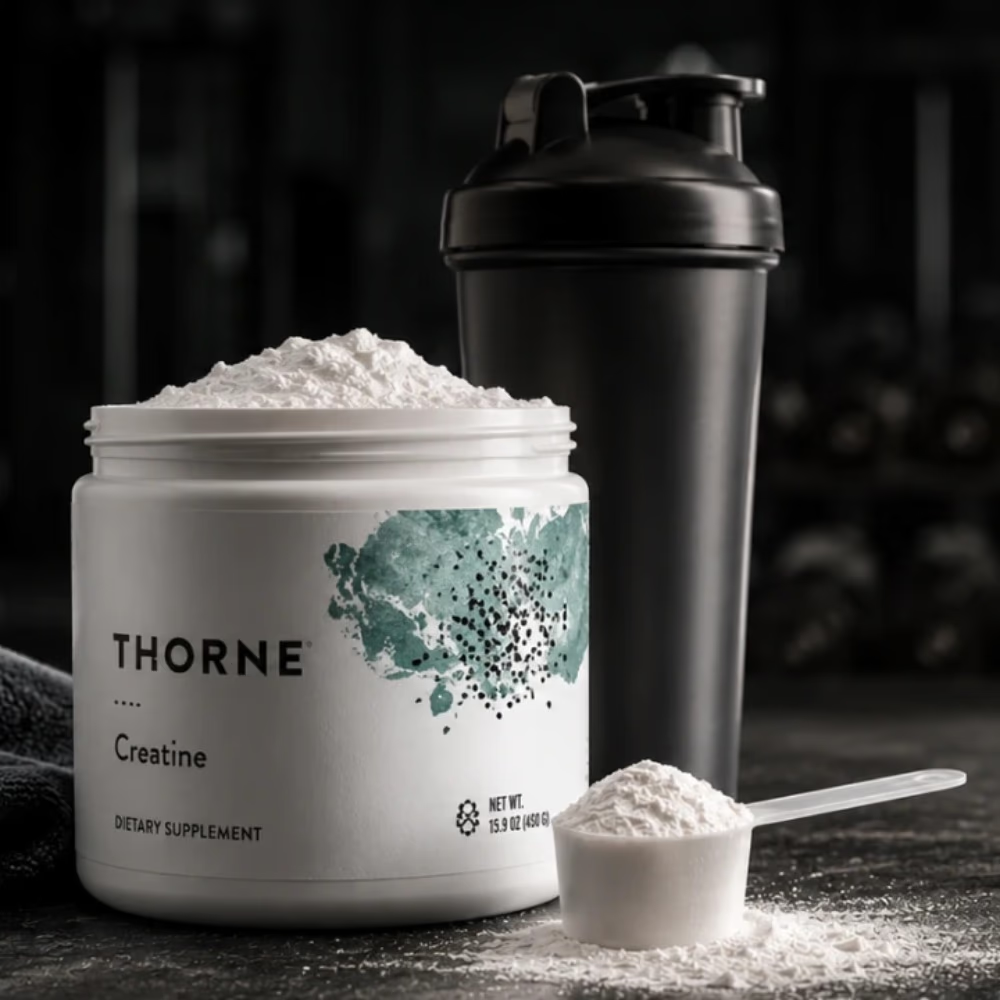
You get some creatine from red meat and fish, but food alone rarely fills your muscle stores. That is what a supplement does. A pure, NSF-certified creatine monohydrate like Thorne is simply creatine with nothing else added, which is all the research supports and all you actually need.
What are the benefits of creatine?
Creatine is the most effective legal supplement for building strength, power, and lean muscle. That is not marketing. The International Society of Sports Nutrition, after reviewing decades of trials, names it the single most effective supplement for high-intensity performance and muscle gain. It works by letting you train harder, and harder training is what drives the results.
Women benefit just as much as men. The strength and lean-mass gains are the same, and the old idea that creatine is a men-only supplement comes from the bloating myth we clear up below. There is no separate women's version and no reason to skip it.
You may also see headlines about creatine and brain health. That research is genuinely promising but still early. In 2024 the European Food Safety Authority reviewed the cognition claims and could not confirm a cause-and-effect link, so treat any brain benefit as emerging, not proven.
Buy creatine for training first. Anything else is a possible bonus, not the reason.
Do you need a creatine loading phase?
No, loading is optional. Loading saturates your muscles faster, in about a week, but taking 3 to 5 grams a day with no loading reaches the exact same saturation in three to four weeks. You end up in the same place. The only difference is how quickly you get there.
Approach | Dose | Time to full effect | Best for |
Load, then maintain | About 0.3 g/kg per day (roughly 20 to 25 g) split into 4 or 5 doses for 5 to 7 days, then 3 to 5 g daily | About 1 week | Wanting the effect quickly, ahead of a training block |
Daily only, no loading | 3 to 5 g every day | About 3 to 4 weeks | Keeping it simple and easing in with less early water gain |
For an 80 kg lifter, a loading dose works out to roughly 24 grams a day split across the day, dropping to a single 5 gram scoop afterwards. If loading gives you any stomach discomfort, split it smaller or skip it and go straight to the daily dose. Either route works.
When should you take creatine, before or after a workout?
Take it whenever you will actually remember, because daily consistency matters far more than timing. Creatine works by keeping your muscles saturated over time, not by giving an acute pre-workout hit, so missing the perfect window costs you nothing.
Some studies show a small edge to taking it after training rather than before, likely because your muscles take up nutrients readily then. The effect is minor. On rest days, take it at any time. The habit of taking it every single day is the thing that decides whether it works, not the clock.
Does creatine cause water retention or bloating?
Creatine does pull water into your body, but it draws it inside the muscle cells, not under the skin, so it makes muscle look fuller rather than puffy. Subcutaneous water, the kind that reads as soft or bloated, is not what creatine does. This is the single most misunderstood thing about it.
When researchers have measured it, creatine raised the water held inside muscle cells while the water outside the cells stayed unchanged. In plain terms, the muscle holds more fluid and looks and feels fuller. That early scale jump of one to two kilos in the first weeks is this cell water, not fat and not bloat.
So the body-image fear is backwards. The water goes exactly where a lifter wants it. If anything, creatine makes trained muscle look better defined, not worse.
Is creatine safe, and does it affect your kidneys?
For healthy people, creatine is one of the most thoroughly studied and safest supplements available. Reviews of long-term use report no harmful effects in healthy adults taking it daily, including at doses far above the normal 5 grams. The kidney worry rests on a misread lab number.
Here is what actually happens. Your body breaks a little creatine down into creatinine, a normal waste product that doctors measure to estimate kidney function. Take more creatine and your blood creatinine rises simply because there is more of it passing through, not because your kidneys are struggling. It is a harmless byproduct, not a sign of damage.
There is one honest exception. If you already have a kidney condition, check with a doctor before starting creatine, and tell them you take it so a raised creatinine reading is read correctly. For everyone with healthy kidneys, sensible daily use is well supported. If you are unsure about your own situation, a MedX pharmacist can point you in the right direction.
Here is the quick version of the myths worth putting to rest.
The worry | The reality |
It will make me look bloated | Water goes inside the muscle, not under the skin, so muscle looks fuller, not puffy |
It damages your kidneys | In healthy people it does not. It raises blood creatinine as a harmless byproduct, not a sign of damage |
It is only for men | Women benefit equally for strength and lean muscle |
Timing is everything | Daily consistency matters far more than the exact time you take it |
Advanced forms work better | Plain monohydrate is the most researched and effective form there is |
Which creatine should you buy in the UAE?
Buy plain creatine monohydrate. It is the form nearly every study used, and the fancier, pricier versions marketed as more advanced have never been shown to beat it. Paying more usually buys you a nicer label, not better results.
The one thing worth paying attention to is third-party testing. A plainly-labelled monohydrate that carries NSF Certified for Sport, like Thorne, has been independently checked for what is on the label and for banned substances, which matters if you compete or just want to trust what you are swallowing. Prices move, so check the current price on MedX before you buy.
If you want a straight ranking of brands and value in the local market, the best creatine monohydrate to buy in the UAE is covered in its own guide. And if you are still deciding where creatine fits alongside other
supplements, see how creatine stacks up against BCAAs and EAAs before you spend on anything else.
Frequently Asked Questions
Does creatine make you gain weight?
A little, and it is not fat. Most people gain one to two kilos in the first few weeks, which is water drawn into the muscle as your stores fill. It levels off. Any longer-term weight gain after that is the lean muscle you build by training harder.
Should you take creatine on rest days?
Yes. Creatine works by keeping your muscles saturated over time, so a daily dose matters even when you do not train. Take your usual 3 to 5 grams at any time on rest days. Skipping days slowly lets your stores drop.
Do you need to cycle off creatine?
No. There is no need to cycle creatine on and off. It is safe to take continuously in healthy people, and stopping just lets your muscle stores gradually return to baseline over a few weeks, which works against you.
Does creatine cause cramps or dehydration?
No good evidence supports that. Despite the old gym rumour, controlled research has not found creatine increases cramping or dehydration, and if anything it slightly raises the water your muscles hold. Drink normally and train as usual.
Does creatine cause hair loss?
There is no reliable evidence that it does. The concern traces to a single small study that noted a change in a hormone linked to hair loss, not hair loss itself, and it has not been repeated or confirmed. On current evidence, creatine is not a cause of hair loss.
Can you take creatine with coffee or pre-workout?
Yes. Creatine mixes fine with coffee, pre-workout, or a protein shake, and many pre-workouts already include it. Taking it with some carbohydrate or protein may help your muscles absorb it slightly better, though it is not essential.
Does creatine work if you do not exercise?
Not much. Creatine gives you the capacity to train harder, and the strength and muscle gains come from that harder training. Without a training stimulus, there is little for the extra creatine to do.
How long does creatine take to work?
With a loading phase, about a week. Taking 3 to 5 grams daily with no loading, about three to four weeks to fully saturate your muscles. Once saturated, the performance benefit is the same either way, so pick the route that suits you.
The smart, safe way to use creatine
Creatine is one of the safest and best-value supplements a lifter can take. The water it stores goes into the muscle where you want it, it does not harm healthy kidneys, and it does not need a complicated routine to work. Start with a plain, verified creatine monohydrate, take 3 to 5 grams every day, and let consistent training do the rest. If you have a kidney condition or any doubt, a MedX pharmacist is a message away before you begin.
Building a wider routine? It is worth knowing about pairing creatine with a pre-workout and adding BCAAs to your stack once your creatine habit is in place.
all blogs