


How Early Can a Pregnancy Test Detect? Early-Detection Tests Compared
Jul 20, 2026
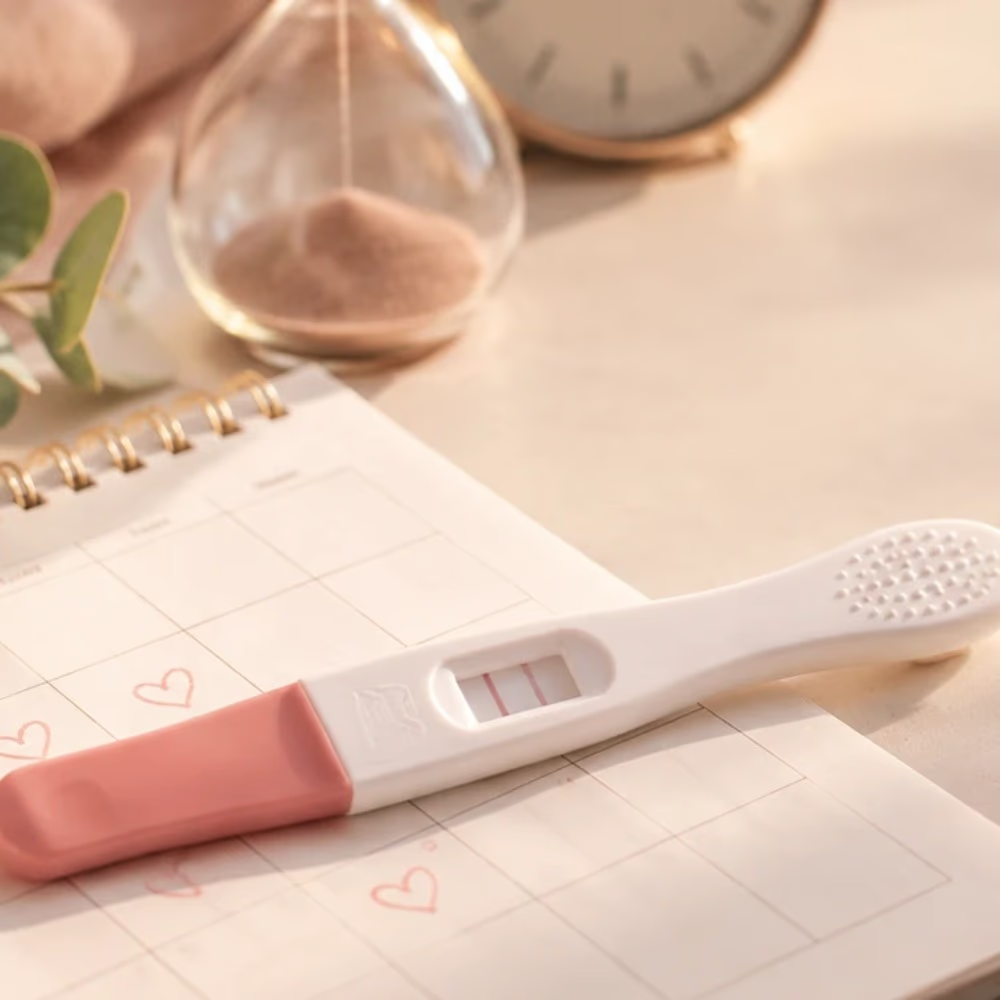
The most sensitive early-detection pregnancy tests can pick up hCG, the hormone your body makes after implantation, up to 6 days before your missed period. That is the honest headline. The catch is that testing this early trades certainty for speed, so even a real pregnancy can read negative when there is not enough hCG to find yet.
If you are deep in the two-week wait and want to test right now, this guide lines up the tests you can actually buy in the UAE by how early each one truly works. It explains why an early negative is not a no, and gives you one simple rule for testing early without setting yourself up for heartbreak.
How early can a pregnancy test detect pregnancy?
An early-detection pregnancy test can detect pregnancy up to 6 days before your missed period, which is about 5 days before your period is due. That is the ceiling for the most sensitive tests on the market. Standard tests are reliable from the day your period is late, not before.
The reason comes down to hCG. Your body only starts making it once an embryo implants, roughly 6 to 12 days after ovulation. From there hCG rises fast, doubling every 48 to 72 hours, according to Cleveland Clinic and UT Southwestern. So the earliest a test can work depends on two things, when you implanted and how sensitive your test is. Test before there is enough hCG, and you get a negative no matter how pregnant you are.
If you want the earliest possible read, you need a test built for it. The First Response Early Result test is designed to detect hCG 6 days before your missed period, which puts it at the front of the pack for a home test.
What test sensitivity (mIU/mL) actually means
Test sensitivity is the smallest amount of hCG a test can pick up, measured in milli-international units per millilitre (mIU/mL). The lower that number, the earlier the test can catch a pregnancy. High-sensitivity home tests detect around 20 to 50 mIU/mL, with 25 mIU/mL a common cut-off.
Think of it like a smoke detector. A more sensitive one goes off with a fainter wisp of smoke. A test set at a 20 mIU/mL threshold catches a fainter hCG signal than one set at 50, which is why it can read positive a day or two sooner.
A lab blood test is more sensitive again, picking up hCG as low as about 1 mIU/mL. That is part of why a clinic can confirm a pregnancy slightly earlier than any home test, though for most people a sensitive home test is all they need.
Early-detection pregnancy tests compared
Here is how the tests a UAE shopper actually reaches for stack up, using only figures each manufacturer or clinical source publishes. Where a brand does not state an exact sensitivity, the table says so rather than guessing.
Test | hCG sensitivity (mIU/mL) | Earliest sensible test day | Accuracy that early | Availability at MedX |
First Response Early Result | Not published on packaging | 6 days before missed period (5 days before expected period) | About 76% of pregnancies detected 5 days before expected period | Stocked at MedX (currently out of stock, check availability) |
Novamed midstream (standard) | Not stated by manufacturer (standard tests are typically around 25) | From the day of your missed period | Over 99% from the day the period is due | In stock at MedX |
Clearblue Early Detection (reference) | Not published as a single figure | 6 days before missed period | About 77% to 78% of pregnancies detected 6 days before missed period | Reference brand, check MedX range |
Blood (serum) hCG test | As low as about 1 to 5 | Around 7 days after ovulation, slightly earlier than urine | Lab confirmed | Clinic or lab, not a home test |
The pattern is clear. An early-detection test buys you a few days at the front end. A standard midstream test is just as reliable once your period is actually due, and a blood test edges out them all but means a clinic visit.
Can you test before a missed period? How many days early?
Yes, you can test before a missed period, but how many days early depends on when you ovulated. hCG only starts once the embryo implants, usually 6 to 12 days past ovulation (DPO). A sensitive test can pick it up from about 7 to 10 DPO, which for many people falls a few days before the period is due.
Timing of day matters too. First-morning urine is the most concentrated, so hCG sits at its highest and is easiest to catch. Test in the evening after a few glasses of water and you dilute the very signal you are hunting for. The earliest sensible day for a high-sensitivity test is about 5 to 6 days before your expected period. Earlier than that, and you are mostly testing your patience.
Are early pregnancy tests accurate this early?
Early pregnancy tests are accurate, but accuracy climbs sharply as you get closer to your missed period. The most sensitive tests detect roughly 76% to 78% of pregnancies at 5 to 6 days before the period is due, per First Response and Clearblue. From the day your period is actually due, that jumps to over 99%.
So the two directions are not equal. A positive early is trustworthy, because hCG only shows up if it is genuinely there. An early negative is not, because you might have tested before your hCG crossed the line, or before you even implanted. Whether an early negative is real comes down to how much hCG is present on the day you test, and that varies from person to person and cycle to cycle.
One older review found real-world accuracy dropped to about 75% when instructions were misread, so following the timing and steps on the leaflet is not optional. A test is only as good as the way you use it.
What to do if you get a negative but no period
If you get a negative but your period has not arrived, wait 2 to 3 days and test again with first-morning urine. hCG roughly doubles every 48 to 72 hours, so a level too low to detect today can be easily readable by the weekend. A negative that early reflects timing, not a final answer.
If your period stays away and tests keep reading negative for a week or more, or if you have pain or unusual bleeding, see a doctor. A blood test settles the question in a way a home test cannot, and it is the right next step when the drugstore result and your body disagree.
Which early-detection test should you buy in the UAE?
For the earliest read, an early-detection test like First Response Early Result is the one to reach for, because it is built to detect hCG 6 days before your missed period. It is the gold standard when you cannot wait for the missed-period date.
If it is not in stock when you need it, the Novamed one-step test is a dependable everyday choice that is over 99% accurate from the day your period is due, and it is available at MedX right now. For most people, that is all the test they will ever need.
If you are still working out when you even ovulate, Easy@Home ovulation tests help you pin down your fertile window, so you know which days a pregnancy test could realistically work in the first place. For the exact best day to test rather than the earliest possible day, see our guide on the best day to take a pregnancy test.
If you want the mechanics first, how home pregnancy test kits work walks through what the lines mean and how the chemistry does its job. And if your cycle is unpredictable, tracking ovulation with LH strips is the piece that tells you when your fertile window opens, which is the anchor for every test date after it.
Whatever you buy, treat a positive as a strong signal to confirm with your doctor. If you want to talk it through before you order, MedX has a pharmacist you can message directly.
Frequently Asked Questions
Can a pregnancy test be positive before a missed period?
Yes. A high-sensitivity early-detection test can read positive up to 6 days before your missed period, once enough hCG has built up. A positive that early is reliable. A negative that early is not, because hCG may still be too low to detect, so retest closer to your period date.
How soon after sex can I take a pregnancy test?
Not the next morning. The pregnancy hormone only appears after the embryo implants, which is usually 6 to 12 days after ovulation, not after sex. Counting from ovulation rather than intercourse, the earliest a sensitive test can work is about 7 to 10 days later.
Does a faint line mean I am pregnant?
A faint line usually means a positive with a low hCG level, which is common when you test early. Any line in the result window, however faint, is generally a positive. Retest in 2 to 3 days with first-morning urine, and the line should darken as hCG rises if the pregnancy is progressing.
Which detects a pregnancy earlier, a blood test or a urine test?
A blood test. A lab blood test detects hCG as low as about 1 mIU/mL and can confirm a pregnancy slightly earlier than a home urine test, which usually needs around 20 to 50 mIU/mL. For most people a sensitive home test is enough, with a blood test to confirm.
What if my cycle is irregular and I do not know when my period is due?
If your cycle is irregular, count from ovulation instead of a due date. Ovulation strips help you find that day. Test about 14 to 16 days after you ovulate. If you are unsure when you ovulated, wait until the longest your cycle has ever run before you trust a negative.
What is the best time of day to take an early pregnancy test?
First thing in the morning. First-morning urine is the most concentrated, so hCG levels are at their highest and easiest to detect. This matters most when you are testing early. Later in the day, once you have had fluids, hCG is diluted and a very early pregnancy can slip under the line.
Can testing too early give a false negative?
Yes, this is the most common reason for a false negative. If you test before there is enough hCG, or before implantation has happened, the test reads negative even though you are pregnant. That is why an early negative is not a no. Wait a few days and retest.
Testing early without the heartbreak
An early-detection pregnancy test buys you a few days, not a guarantee. The reliable approach is simple. Test early with a sensitive test if you cannot wait, and if it reads negative, test again with first-morning urine at your missed period before you believe it. A positive, even a faint one, is your cue to confirm with a doctor.
If you would rather have a test waiting in the drawer before the day comes, MedX stocks early-detection and everyday options with UAE delivery, plus a pharmacist you can message if you want a second opinion first.
all blogs