


Pregnancy Tests: How They Work and Which One to Buy in the UAE
Jul 20, 2026
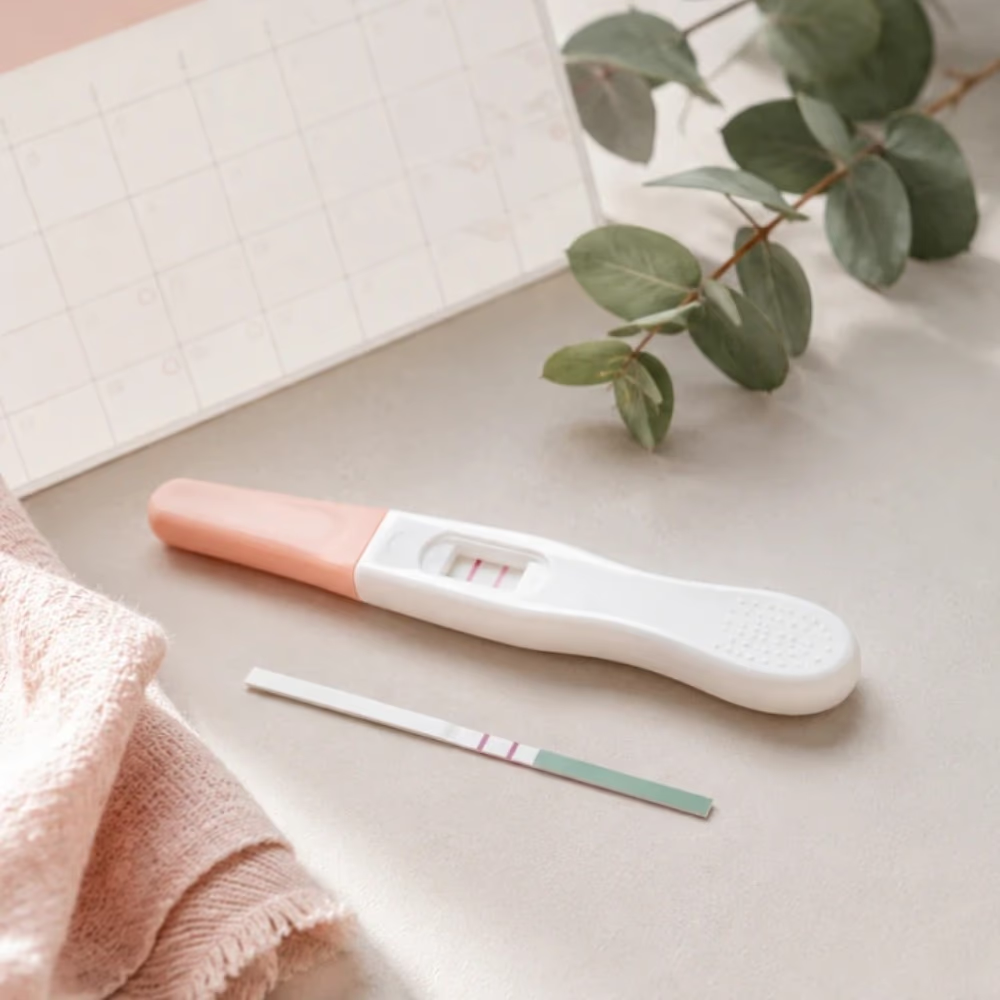
If you are counting days and staring at the pharmacy shelf, you want two things from a pregnancy test: an answer as early as possible, and one you can trust. Here is the part the box does not spell out.
A pregnancy test detects hCG, the hormone your body starts making a few days after a fertilised egg implants. Every home test does that same job. What separates them is sensitivity, meaning how little hCG they need to show a positive. That one number decides how early you can test and which test is worth buying.
How does a pregnancy test work?
A pregnancy test is an at-home diagnostic that detects human chorionic gonadotropin, or hCG, a hormone your body produces in early pregnancy. It uses antibodies on a strip that react with hCG in your urine and show a result as a line, a symbol, or a word. How early it works depends on the test's sensitivity.
hCG appears after a fertilised egg implants in the uterus wall, roughly six to seven days after fertilisation, and its level climbs quickly from there. The antibodies inside the test are tuned to react once hCG passes a set threshold. Below that level you see no positive line, even in early pregnancy. Above it, the test reacts and shows a result.
This is why timing and urine concentration matter. First-morning urine holds the most hCG because it has been building overnight, so testing first thing gives the earliest honest reading. It is also why an early-detection test like First Response Early Result is designed to react to very low hCG levels, letting it pick up a pregnancy a few days before your period is even due.
What does pregnancy test sensitivity mean?
Sensitivity is the smallest amount of hCG a test can detect, measured in milli-international units per millilitre (mIU/mL). The lower the number, the less hCG the test needs, and the earlier it can show a positive. A test rated at 6.3 mIU/mL can catch a pregnancy several days before one rated at 25 mIU/mL.
That makes sensitivity the single figure worth checking before you buy. How early a test works depends on it. A 6.3 mIU/mL test can detect hCG a few days before a missed period. A 25 mIU/mL test is reliable from the day your period is late. Here is how the tiers compare.
Sensitivity tier | Typical rating | How early it can detect | Example |
Early-detection | 6.3 to 10 mIU/mL | A few days before a missed period | First Response Early Result (6.3), Clearblue Early Detection (10) |
Standard | 20 to 25 mIU/mL | From the day the period is late | Most value midstream tests, Novamed (about 20) |
Clinic blood test | 1 to 5 mIU/mL | Earliest of all, needs a clinician | Lab hCG test at a doctor or clinic |
Analytical sensitivity figures for consumer tests come from published comparisons and manufacturer data. First Response Early Result has been measured at 6.3 mIU/mL, among the most sensitive home tests available.
Strip, midstream, cassette or digital: which format?
The format changes how you use the test and how it shows the answer, not the underlying science. Every one of them still reacts to hCG. The right format comes down to how you prefer to test and whether you want to avoid squinting at a faint line.
Format | How you use it | Typical sensitivity | Shows result as | Best for |
Strip (dip) | Dip the strip into collected urine | 10 to 25 mIU/mL | Two lines | Frequent early testing on a budget, TTC tracking |
Midstream | Hold in the urine stream or dip | 20 to 25 mIU/mL | Two lines | The everyday choice, simple and quick |
Cassette (dropper) | Drop urine into a small well | About 25 mIU/mL | Two lines | A controlled, clinic-style test |
Digital | Hold in the stream or dip | 10 to 25 mIU/mL | Words such as Pregnant or Not Pregnant | Removing the guesswork of reading lines |
A digital test earns its higher price by taking the anxiety out of reading a faint line. If a clear word matters more to you than a few dirhams, it is worth it. If you plan to test often, cheaper strips let you do that without spending much each time.
How accurate are home pregnancy tests?
From the day of your missed period, a good home pregnancy test is more than 99% accurate. That is the number worth trusting. The trouble is that boxes advertise a second number next to it, and the two are not the same promise.
A claim like 6 days sooner describes how early a sensitive test can pick up hCG. A claim like over 99% accurate describes how reliable it is once your period is late. Testing at the earliest edge of what a test can do is not the same as testing when it is most accurate. The chance of a real pregnancy showing up climbs steeply as you get closer to your expected period.
When you test | Approx. pregnancies detected |
5 days before your period is due | About 76% |
3 days before your period is due | About 96% |
2 days before to the day it is due | Over 99% |
From the day of your missed period | Over 99% |
Detection rates are manufacturer figures for early-result tests. The pattern is what matters. Test very early and a negative is often wrong, because there simply is not enough hCG yet.
So a negative test five days before your period does not mean you are not pregnant. hCG roughly doubles every 48 to 72 hours, so if you test early and see one line, retest in two to three days and it may well turn positive. For the full picture on exactly when to take a pregnancy test, and on how early each test can detect, our companion guides go deeper than we can here.
Which pregnancy test should you buy in the UAE?
The best test is not the one with the boldest claim on the box. It is the one matched to when you are testing. Get that right and you avoid both a false scare and a wasted early result.
If you want to test before your period is due
Reach for the most sensitive test you can get. The 6-day-early test from First Response reacts at 6.3 mIU/mL, which is why it can show a result several days before a missed period. It comes as a twin pack, which is genuinely useful here, because early testing often means testing twice as hCG rises.
If you are testing from the day your period is late
You do not need to pay for extra sensitivity. A reliable value midstream test such as Novamed detects at around 20 mIU/mL and gives a dependable answer once your period is due. Value midstream tests in the UAE typically run about AED 15 to 26, so confirming a result costs very little. Prices move, so check the current price on MedX before you buy.
If a result leaves you unsure, whether it is a faint line or a stubborn negative, a MedX pharmacist can talk it through with you before you decide what to do next.
Frequently Asked Questions
Can I get a false negative?
Yes, and it is the most common wrong result. A false negative usually means you tested too early, before hCG had risen enough to detect, or used diluted urine later in the day. If your period has not arrived, retest in two to three days with first-morning urine.
Can I get a false positive?
False positives are rare. They can follow a recent pregnancy loss, come from certain fertility treatments that contain hCG, or appear as an evaporation line if you read the test after its time window. Read your result within the minutes the instructions state, not later.
Is a faint line positive?
A faint line usually counts as positive. It means hCG is present but still low, which is common when you test early. To be sure, retest in 48 hours and the line should darken as hCG rises, or use a digital test that shows a word instead of a line.
How early can I really test?
It depends on the test's sensitivity. A 6.3 mIU/mL early-detection test can pick up a pregnancy a few days before your period is due. A standard 25 mIU/mL test is reliable from the day your period is late. Earlier than that, expect less certainty.
What is the most accurate pregnancy test?
From the day of a missed period, any reliable brand is over 99% accurate, so accuracy at that stage is less about the brand and more about following the instructions. Before a missed period, an early-detection test is the most sensitive choice, though no test is fully certain that early.
Does the time of day matter?
For early testing, yes. First-morning urine is the most concentrated, so hCG is at its highest and a positive is easier to catch. Once your period is clearly late, hCG is high enough that any time of day works fine.
What should I do after a positive result?
Treat a positive as your cue to see a doctor, who can confirm the pregnancy and start your care. A home test is a strong first signal, not a medical diagnosis. Booking that appointment early is the right next step.
What if the test stays negative but my period has not come?
Retest in two to three days, since hCG may simply have been too low the first time. If it stays negative and your period is still absent, see a doctor. A late period has several possible causes worth checking beyond pregnancy.
The right test is the one matched to your moment
A pregnancy test cannot be judged by the loudest claim on its box. Before your period is due, an early-detection test gives you the earliest honest answer. From the day it is late, any reliable test tells you clearly and cheaply. If you are unsure at any point, a MedX pharmacist is a message away, and a positive result is your signal to see a doctor and begin care with confidence.
Trying to time it right, or planning ahead? Tracking ovulation with LH strips is the other half of the same journey, and worth a look if you are trying to conceive.
all blogs