


Tretinoin 0.025% vs 0.05%: Which Strength Should You Start With?
Jul 01, 2026
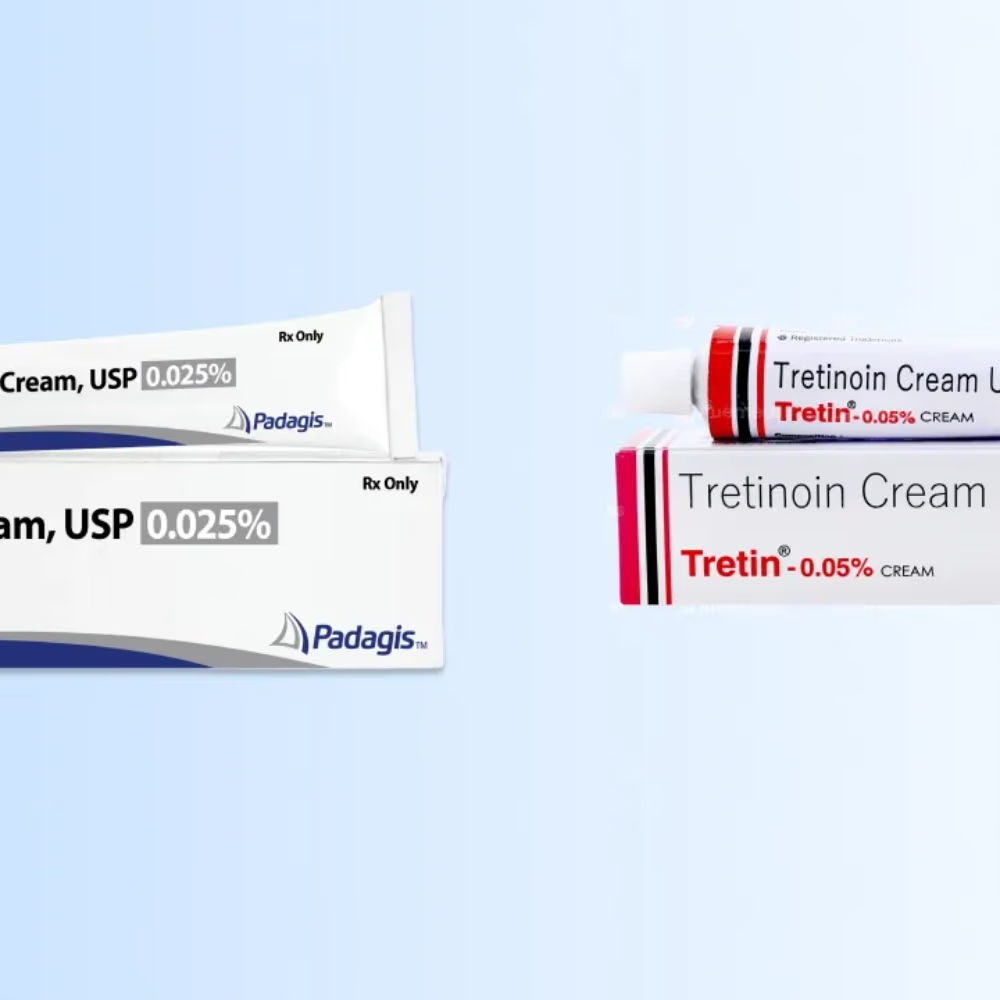
Between tretinoin 0.025% and 0.05%, the stronger one is not the better one. Both reach comparable long-term results. The 0.05% cream just gets there faster and with more irritation. For almost every beginner, 0.025% is the right place to start.
This page settles the strength decision, nothing more. If you are still working out what tretinoin actually is and how its timeline runs, start with our guide to what tretinoin is and how it works, then come back here for the choice between the two strengths. One thing to fix in mind from the outset: both are prescription-only in the UAE, so a doctor or pharmacist sets your strength, not a checkout button.
What's the real difference between 0.025% and 0.05%?
Tretinoin 0.025% and 0.05% are two strengths of the same prescription retinoid. The 0.025% cream is the standard starter strength, gentler and lower-irritation. The 0.05% cream works faster but causes more redness and peeling. Long-term, both reach comparable results, so the lower strength suits most beginners.
The active molecule is identical. What changes is the dose, and the dose is what your skin feels. Higher concentration means faster cell turnover, which means quicker visible change and a rougher adjustment period. Here is the side-by-side.
Tretinoin 0.025% | Tretinoin 0.05% | |
Potency | Standard starter strength. Gentler on the skin. | Intermediate strength. Roughly double the concentration. |
Best for | First-time users, sensitive or dry skin, anyone easing in. | Resilient skin that has already tolerated 0.025% well. |
Irritation risk | Lower. Less redness, dryness, and peeling. | Higher. More redness, flaking, and barrier disruption early on. |
Speed to visible results | Slower to show, smoother ride. | Faster to show, harsher ride. |
Long-term result | Comparable to 0.05% over time. | Comparable to 0.025% over time. No long-term advantage. |
Start here? | Yes, for most people. | Only as a step-up, once 0.025% is easy. |
Is stronger tretinoin actually better?
No. Stronger tretinoin is faster, not better. A landmark study by Griffiths and colleagues (1995) compared 0.025% and 0.05% tretinoin directly and found they produce similar clinical and histological improvement over time, while the higher strength caused significantly more irritation. Same destination, rougher road.
That single finding is the answer to the question driving most of these searches. The instinct that a higher number must mean a better outcome is wrong here. The extra strength buys you a shorter timeline, and it charges for it in redness, dryness, and peeling. If your skin reacts badly enough that you quit, you end up worse off than someone who stuck with 0.025% for a year.
This is why consistency beats concentration. A strength you can use steadily for months, without flaring and stopping, will outperform a stronger cream you abandon. The cream only works on the nights you actually apply it.
Is 0.05% too strong for beginners?
For most beginners, yes, 0.05% is too strong to start with. Jumping straight to 0.05% without building tolerance usually means more redness, flaking, and barrier damage than your skin can settle, which is the most common reason people give up on tretinoin entirely.
Skincare communities are full of exactly this regret. One widely shared account describes 0.05% as honestly very strong for most skin types after it made their skin worse. Another sums up the fix in a line many users echo. Sometimes less is more, and switching down to 0.025% settled all their tretinoin problems. The pattern is consistent enough to take seriously.
If prescription tretinoin feels too aggressive even at 0.025%, a gentler over-the-counter option is a reasonable starting point. Our retinol beginner's guide walks through that softer entry, and you can graduate to prescription tretinoin later once your skin is used to a retinoid.
Which strength should you start with?
Start with 0.025% unless you have already tolerated a retinoid well and want to move faster. The right starting strength comes down to three things: your skin's tolerance, your goal, and your retinoid experience. The matrix below maps those to a sensible starting point and frequency.
Your profile | Acne goal | Anti-aging goal | Frequency to start |
Sensitive or dry skin, first retinoid | 0.025% | 0.025% | 2 to 3 nights a week, build up slowly |
Normal skin, first retinoid | 0.025% | 0.025% | Every other night, then nightly |
Oily, resilient skin, used retinoids before | 0.025%, or 0.05% if 0.025% was easy | 0.05% acceptable under guidance | Every other night, then nightly |
Pigmentation or melasma focus | See the combination section below | See the combination section below | Doctor-set regimen only |
Whichever row you land on, the strength is a decision you confirm with a professional, because tretinoin is prescription-only here. If your doctor or MedX pharmacist agrees you are ready to step up, Acretin's 0.05% cream is the strength MedX stocks for that move. If you are at the very beginning, start with the 0.025% strength instead and give it time.
Can you use 0.05% every day?
You can use 0.05% nightly once your skin has built up to it, but not from day one. Start at two or three nights a week, let any initial dryness and flaking settle, then increase frequency over several weeks. Going straight to every night at full strength is what triggers the worst irritation.
Think of it the way you would a new exercise routine. You do not run a marathon in week one. You build the tolerance first, then the volume. Skin adapts to tretinoin the same way, which is why the slow build is the standard, not a sign you are being overly cautious.
When should you move up from 0.025% to 0.05%?
Move up from 0.025% to 0.05% only when you have used the lower strength nightly for several months, with no ongoing irritation, and your progress has clearly plateaued. If you are still flaking or red, or still seeing steady improvement, there is no reason to change.
In practice, three signals together say you are ready:
- You have been applying 0.025% every night for at least three to six months.
- Your skin no longer reacts. No persistent redness, dryness, or peeling.
- Your results have stalled. The improvement that came steadily has levelled off.
Hit all three and a step up is reasonable. Miss any one and you are better off staying put. Moving up early does not speed your results, it just resets the irritation clock. Confirm the change with your doctor or pharmacist rather than swapping strengths on your own.
What about hydroquinone with tretinoin for dark spots?
Hydroquinone with tretinoin is a prescription regimen a dermatologist supervises, not a combination you mix at home. The standard form is the modified Kligman formula, which pairs hydroquinone, tretinoin, and a mild corticosteroid in one doctor-set prescription for melasma and stubborn dark spots. It is effective, and it is also why this needs supervision.
The reason for the caution is real. Long-term, unsupervised hydroquinone use can cause exogenous ochronosis, a permanent blue-grey skin discolouration that is difficult to reverse. Research published in the Journal of the European Academy of Dermatology and Venereology documents both the strong results of the supervised regimen and this risk when hydroquinone is used unmonitored. That is the trade-off a dermatologist manages by capping how long you use it.
Do not combine these yourself, and do not treat any concentration you read online as a recipe. If your skin concern is pigmentation, the right move is a doctor's assessment. Where a combination product is appropriate, it is dispensed as a prescribed product such as Acretin-C, set up through a professional, not assembled from separate tubes.
0.025% vs 0.05% for acne vs anti-aging
For both acne and anti-aging, 0.025% is the sensible starting strength, and the goal changes the partners more than the percentage. Tretinoin treats inflammatory and comedonal acne and softens fine lines and photoaging through the same mechanism of faster skin turnover.
For acne, tretinoin is often paired with other actives that target the bacterial side of breakouts, such as a topical antibiotic for inflammatory acne. For anti-aging, the strength question matters less than consistency and daily sunscreen, since tretinoin makes skin more sun-sensitive. The percentage is the same decision either way. Start low, stay steady, protect from the sun.
How to get the right strength in the UAE
Both tretinoin strengths are prescription-only in the UAE. A doctor or pharmacist should set your strength and confirm it suits your skin. You cannot buy either strength over the counter, and that is a safeguard, not an obstacle.
MedX is a licensed UAE pharmacy that stocks both Acretin strengths and can route you correctly. The practical path is a short conversation with a doctor or a MedX pharmacist about which strength fits your skin and goal, after which you start on the right one. As an indicative figure, a 30g tube of Acretin sits around AED 19, though you should check the current price on MedX since it moves by pack and promotion.
If your skin tends to get irritated as it adjusts, keeping a soothing cream to calm tretinoin irritation on hand makes the first few weeks far more bearable. Barrier support is exactly what a new tretinoin user needs.
Tretinoin strength FAQ
Is 0.05 or 0.025 tretinoin stronger?
Tretinoin 0.05% is the stronger strength, at roughly double the concentration of 0.025%. Stronger means faster visible results and more irritation, not a better long-term outcome, since both strengths reach comparable results over time.
Is tretinoin 0.05 or 0.025 better?
Neither is better long-term. Studies show 0.025% and 0.05% produce similar improvement over time, with 0.05% causing more irritation along the way. For most people, 0.025% is the better choice because it is easier to tolerate consistently.
Should I use 0.025 or 0.05 tretinoin?
Start with 0.025% unless you have already tolerated a retinoid well and want faster results under guidance. The lower strength suits first-timers and sensitive skin, while 0.05% is a step-up for resilient skin that has handled 0.025% easily.
Is 0.05% tretinoin too strong for beginners?
For most beginners, 0.05% is too strong to start with and often causes excess redness and peeling. Building tolerance on 0.025% first, then moving up only if needed, is the standard approach dermatologists recommend.
Can I use tretinoin 0.05 every day?
You can use 0.05% nightly once your skin has built up to it, but not from the start. Begin two or three nights a week, let irritation settle, then increase frequency over several weeks to reach nightly use.
When should I move up from 0.025 to 0.05?
Move up only after using 0.025% nightly for several months with no irritation and a clear plateau in results. If you are still adjusting or still improving, there is no benefit to increasing the strength.
Is hydroquinone and tretinoin safe to combine for dark spots?
Hydroquinone with tretinoin is effective for melasma but only as a dermatologist-supervised prescription, never a home mix. Long-term unsupervised hydroquinone use can cause permanent skin discolouration called ochronosis, which is why it needs medical oversight.
Start tretinoin at 0.025% unless a clear reason says otherwise, move up to 0.05% only once you have earned it, and remember that a tolerable strength used steadily beats a strong one you abandon. The percentage on the tube is the smaller decision. Since both strengths are prescription-only here, your next step is a quick conversation with a doctor or a MedX pharmacist to confirm the right strength and start on the matching Acretin cream.
Medical disclaimer: This article is for general information and is not medical advice. Tretinoin and hydroquinone are prescription medicines. Tretinoin is contraindicated in pregnancy and breastfeeding. Consult a licensed doctor or pharmacist before starting any treatment, and never combine prescription actives yourself.
all blogs